System Architecture

Cognitive Decision Engine

At the core of Superpanel is a cognitive decision engine that manages state, evaluates logic, and drives execution across channels.
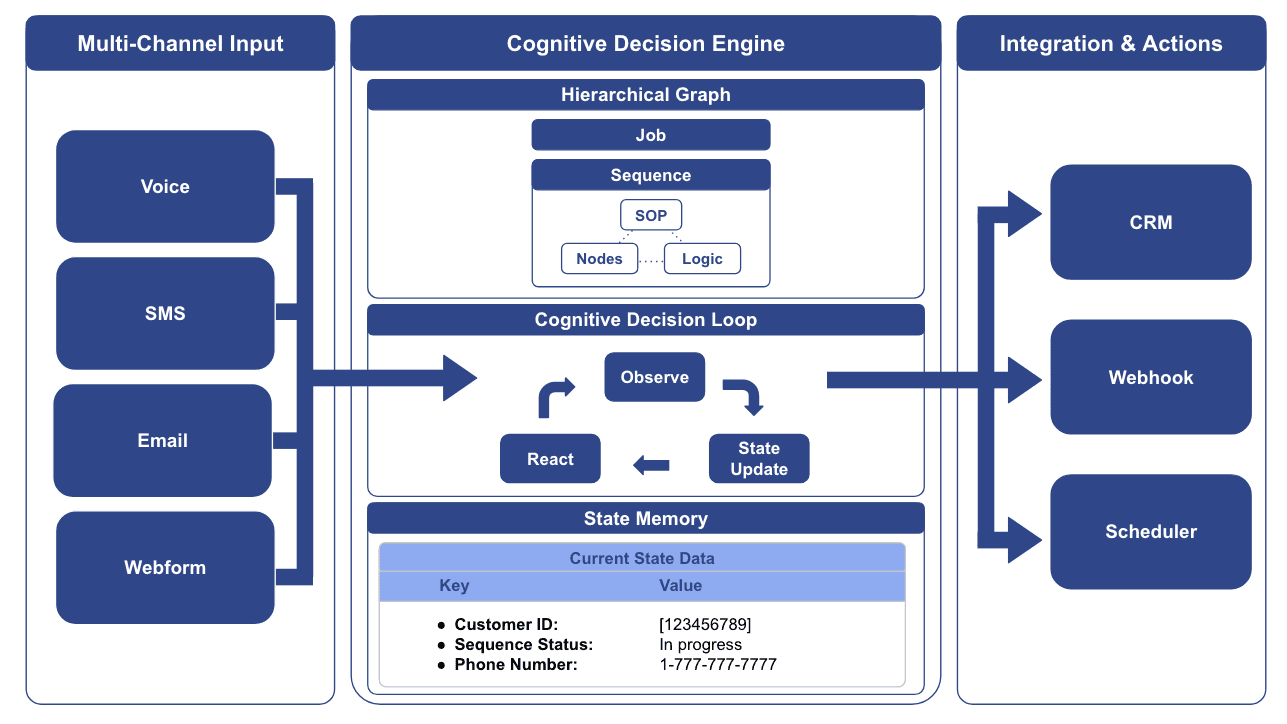
Core System Components

At the core of Superpanel is a cognitive decision engine that manages state, evaluates logic, and drives execution across channels.

The architecture is composed of the following core system components.

Job outcome:

A Job represents a complete business outcome, such as a qualified intake or signed retainer.

  • Outcome-based and ownership-driven

  • Persisted until an end state is reached

  • Can span multiple channels and multiple sessions

A Job is anchored to a single contact and is executed through one or more Sequences.

Sequence: 

A Sequence is an ordered group of steps (see: nodes) that completes a major portion of a Job. 

Examples include: Initial information collection, Document gathering and validation, Qualification or disqualification, Signed retainer or agreement flow

Sequences are defined by customer SOPs and are fully programmable.

Key properties:

  • Independently versioned

  • Testable in sandbox environments

  • Deployable without impacting other Sequences

Standard Operating Procedure (SOP):

An SOP defines how a Sequence is executed. It is composed of nodes and decision logic.

Nodes

Nodes represent an individual step in a sequence. Each node has a specific micro-goal.

Examples: Contact information collection, Eligibility verification, Disqualification handling

Each node includes:

  • Talking points to communicate

  • Questions mapped to required state fields

  • Node-level decision logic (see below)

Decision logic

Decision logic consists of conditional rules that are custom coded to each individual customer. This controls the system behavior based on the current state.

Logic is defined at two levels.

  • Sequence-level logic: defines and encodes conditional rules that govern the behavior of an entire Sequence. This includes:

    • Follow-up rules, such as when and how often the digital teammate should re-engage a contact

    • Escalation rules, such as when an interaction should be handed off to a human operator

    • Completion rules, such as when and how a Sequence should end, including disqualification cases

This coded logic ensures consistent execution across all steps in the Sequence.

  • Node-level logic: defines conditional rules that governs how an individual node achieves its micro-goal. For example, if a node is responsible for disqualifying ineligible cases, node logic determines the next action based on the specific disqualification reason, such as product ownership, age, details of an incident description, local statutes of limitations, or other multivariate criteria.

Custom code can be written at both levels to support the unique business and industry needs of each customer, including decision rules, end state outputs, branching behavior, and external integrations.

This logic provides strict guardrails that enable compliance while allowing the digital teammate to operate autonomously and make thousands of accurate decisions and actions related to each contact without hallucination.

State Memory: 

State is the system’s memory.

It is represented as a structured set of slots (or fields) that capture:

  • Information required to complete the Job

  • Metadata about execution and progress

Examples include contact details, eligibility attributes, incident details, parties involved in an incident, evidence documents, last interaction time, sequence status, and thousands of other data points that comprise a state.

Digital teammates do not guess or infer missing data. Each action exists to populate a specific state field. Progress only occurs when the state requirements allow it to.

System Architecture

System Architecture
System Architecture

Cognitive Decision Engine

Cognitive Decision Engine

Cognitive Decision Engine

Table of Content

Table of Content

Table of Content

At the core of Superpanel is a cognitive decision engine that manages state, evaluates logic, and drives execution across channels.

At the core of Superpanel is a cognitive decision engine that manages state, evaluates logic, and drives execution across channels.

At the core of Superpanel is a cognitive decision engine that manages state, evaluates logic, and drives execution across channels.

Core System Components

At the core of Superpanel is a cognitive decision engine that manages state, evaluates logic, and drives execution across channels.

The architecture is composed of the following core system components.

Job outcome:

A Job represents a complete business outcome, such as a qualified intake or signed retainer.

  • Outcome-based and ownership-driven

  • Persisted until an end state is reached

  • Can span multiple channels and multiple sessions

A Job is anchored to a single contact and is executed through one or more Sequences.

Sequence: 

A Sequence is an ordered group of steps (see: nodes) that completes a major portion of a Job. 

Examples include: Initial information collection, Document gathering and validation, Qualification or disqualification, Signed retainer or agreement flow

Sequences are defined by customer SOPs and are fully programmable.

Key properties:

  • Independently versioned

  • Testable in sandbox environments

  • Deployable without impacting other Sequences

Standard Operating Procedure (SOP):

An SOP defines how a Sequence is executed. It is composed of nodes and decision logic.

Nodes

Nodes represent an individual step in a sequence. Each node has a specific micro-goal.

Examples: Contact information collection, Eligibility verification, Disqualification handling

Each node includes:

  • Talking points to communicate

  • Questions mapped to required state fields

  • Node-level decision logic (see below)

Decision logic

Decision logic consists of conditional rules that are custom coded to each individual customer. This controls the system behavior based on the current state.

Logic is defined at two levels.

  • Sequence-level logic: defines and encodes conditional rules that govern the behavior of an entire Sequence. This includes:

    • Follow-up rules, such as when and how often the digital teammate should re-engage a contact

    • Escalation rules, such as when an interaction should be handed off to a human operator

    • Completion rules, such as when and how a Sequence should end, including disqualification cases

This coded logic ensures consistent execution across all steps in the Sequence.

  • Node-level logic: defines conditional rules that governs how an individual node achieves its micro-goal. For example, if a node is responsible for disqualifying ineligible cases, node logic determines the next action based on the specific disqualification reason, such as product ownership, age, details of an incident description, local statutes of limitations, or other multivariate criteria.

Custom code can be written at both levels to support the unique business and industry needs of each customer, including decision rules, end state outputs, branching behavior, and external integrations.

This logic provides strict guardrails that enable compliance while allowing the digital teammate to operate autonomously and make thousands of accurate decisions and actions related to each contact without hallucination.

State Memory: 

State is the system’s memory.

It is represented as a structured set of slots (or fields) that capture:

  • Information required to complete the Job

  • Metadata about execution and progress

Examples include contact details, eligibility attributes, incident details, parties involved in an incident, evidence documents, last interaction time, sequence status, and thousands of other data points that comprise a state.

Digital teammates do not guess or infer missing data. Each action exists to populate a specific state field. Progress only occurs when the state requirements allow it to.

Core System Components

At the core of Superpanel is a cognitive decision engine that manages state, evaluates logic, and drives execution across channels.

The architecture is composed of the following core system components.

Job outcome:

A Job represents a complete business outcome, such as a qualified intake or signed retainer.

  • Outcome-based and ownership-driven

  • Persisted until an end state is reached

  • Can span multiple channels and multiple sessions

A Job is anchored to a single contact and is executed through one or more Sequences.

Sequence: 

A Sequence is an ordered group of steps (see: nodes) that completes a major portion of a Job. 

Examples include: Initial information collection, Document gathering and validation, Qualification or disqualification, Signed retainer or agreement flow

Sequences are defined by customer SOPs and are fully programmable.

Key properties:

  • Independently versioned

  • Testable in sandbox environments

  • Deployable without impacting other Sequences

Standard Operating Procedure (SOP):

An SOP defines how a Sequence is executed. It is composed of nodes and decision logic.

Nodes

Nodes represent an individual step in a sequence. Each node has a specific micro-goal.

Examples: Contact information collection, Eligibility verification, Disqualification handling

Each node includes:

  • Talking points to communicate

  • Questions mapped to required state fields

  • Node-level decision logic (see below)

Decision logic

Decision logic consists of conditional rules that are custom coded to each individual customer. This controls the system behavior based on the current state.

Logic is defined at two levels.

  • Sequence-level logic: defines and encodes conditional rules that govern the behavior of an entire Sequence. This includes:

    • Follow-up rules, such as when and how often the digital teammate should re-engage a contact

    • Escalation rules, such as when an interaction should be handed off to a human operator

    • Completion rules, such as when and how a Sequence should end, including disqualification cases

This coded logic ensures consistent execution across all steps in the Sequence.

  • Node-level logic: defines conditional rules that governs how an individual node achieves its micro-goal. For example, if a node is responsible for disqualifying ineligible cases, node logic determines the next action based on the specific disqualification reason, such as product ownership, age, details of an incident description, local statutes of limitations, or other multivariate criteria.

Custom code can be written at both levels to support the unique business and industry needs of each customer, including decision rules, end state outputs, branching behavior, and external integrations.

This logic provides strict guardrails that enable compliance while allowing the digital teammate to operate autonomously and make thousands of accurate decisions and actions related to each contact without hallucination.

State Memory: 

State is the system’s memory.

It is represented as a structured set of slots (or fields) that capture:

  • Information required to complete the Job

  • Metadata about execution and progress

Examples include contact details, eligibility attributes, incident details, parties involved in an incident, evidence documents, last interaction time, sequence status, and thousands of other data points that comprise a state.

Digital teammates do not guess or infer missing data. Each action exists to populate a specific state field. Progress only occurs when the state requirements allow it to.

Core System Components

At the core of Superpanel is a cognitive decision engine that manages state, evaluates logic, and drives execution across channels.

The architecture is composed of the following core system components.

Job outcome:

A Job represents a complete business outcome, such as a qualified intake or signed retainer.

  • Outcome-based and ownership-driven

  • Persisted until an end state is reached

  • Can span multiple channels and multiple sessions

A Job is anchored to a single contact and is executed through one or more Sequences.

Sequence: 

A Sequence is an ordered group of steps (see: nodes) that completes a major portion of a Job. 

Examples include: Initial information collection, Document gathering and validation, Qualification or disqualification, Signed retainer or agreement flow

Sequences are defined by customer SOPs and are fully programmable.

Key properties:

  • Independently versioned

  • Testable in sandbox environments

  • Deployable without impacting other Sequences

Standard Operating Procedure (SOP):

An SOP defines how a Sequence is executed. It is composed of nodes and decision logic.

Nodes

Nodes represent an individual step in a sequence. Each node has a specific micro-goal.

Examples: Contact information collection, Eligibility verification, Disqualification handling

Each node includes:

  • Talking points to communicate

  • Questions mapped to required state fields

  • Node-level decision logic (see below)

Decision logic

Decision logic consists of conditional rules that are custom coded to each individual customer. This controls the system behavior based on the current state.

Logic is defined at two levels.

  • Sequence-level logic: defines and encodes conditional rules that govern the behavior of an entire Sequence. This includes:

    • Follow-up rules, such as when and how often the digital teammate should re-engage a contact

    • Escalation rules, such as when an interaction should be handed off to a human operator

    • Completion rules, such as when and how a Sequence should end, including disqualification cases

This coded logic ensures consistent execution across all steps in the Sequence.

  • Node-level logic: defines conditional rules that governs how an individual node achieves its micro-goal. For example, if a node is responsible for disqualifying ineligible cases, node logic determines the next action based on the specific disqualification reason, such as product ownership, age, details of an incident description, local statutes of limitations, or other multivariate criteria.

Custom code can be written at both levels to support the unique business and industry needs of each customer, including decision rules, end state outputs, branching behavior, and external integrations.

This logic provides strict guardrails that enable compliance while allowing the digital teammate to operate autonomously and make thousands of accurate decisions and actions related to each contact without hallucination.

State Memory: 

State is the system’s memory.

It is represented as a structured set of slots (or fields) that capture:

  • Information required to complete the Job

  • Metadata about execution and progress

Examples include contact details, eligibility attributes, incident details, parties involved in an incident, evidence documents, last interaction time, sequence status, and thousands of other data points that comprise a state.

Digital teammates do not guess or infer missing data. Each action exists to populate a specific state field. Progress only occurs when the state requirements allow it to.